Thursday, September 26, 2013

Delegation Day Domination

Today I'm grateful for how BorderLinks fills my days. I'm still training on delegations, but today I'm amazed by how we spent seven hours in the desert with Humane Borders to check their humanitarian water stations, ate delicious lentil soup cooked by our staff, made conceptual connections between free trade policies and increased migration of human beings, had an amazing presentation by a 19-year-old unDACAmented student from Scholarships A-Z about how he and other undocumented students and allies are working for access to higher education, filled our bellies again on what I attempted to cook for the crew, and then voiced some of our thoughts on how today motivated us to continue working for social justice with our new tools and experiences. My brain is whirring and I still have so much energy after a long day, and tomorrow it's on to the next one!
Check out some photos from the delegations so far! 

 Here's a few photos from my first learning delegation - a single-day delegation with a group of pastors from Duke Divinity School.

Here's Indira, our Program Organizer for this trip! 

Going on a desert walk with Shura from Green Valley Samaritans. We walked trails common for migrants to take, walking in the dark for safety. As we walked, we called out "Somos amigos, somos Samaritanos Tenemos agua, comida, y medicina" - We are friends, we are Samaritans. We have water, food, and medicine - just in case there were people in need of assistance but in hiding.

Here Shura shows us where some people take refuge under the highway for safety.


 Marveling at the modern federal courthouse where we went to observe Operation Streamline (not familiar with Operation Streamline? Don't worry, I'll be blogging about it much more!)

Once in a while we stumble across something unexpected - in the building where we went to visit with a public defendant in immigration cases, we found Senator McCain's office! After our talk with the lawyer, we waltzed right up to the Senator's door, and they let us in to see his office even though he was away at a town hall meeting.


And here's my second training delegation, this time with a group from the Presbytery of Des Moines! A little Midwest connection never hurts. Here's our sunset reflection time at Gates Pass.

This time, I had the opportunity to learn from the delegation styles and expertise of both Alex (BorderLinks) and MaryCruz (HEPAC, our Nogales partner organization). Here's Alex starting the reflection before we lost too much light.
 This morning we followed Jean and Betsy from Humane Borders on their route to check three of their water stations in various points in the desert.


Jean and Betsy checking the level and quality of the water in their recycled blue drum. 


 Ever seen a cow crossing sign? Welcome to free range cattle country.

 We passed by this cactus and of course we had to stop for pictures. As many saguaros are around 100 years old when they first sprout arms, this one with its 30-plus arms must be hundreds of years old.

Old copper mines. 

 A little off the beaten path, Betsy led us to an unexpected site: the graves of numerous Chinese migrants who died in or near the copper mines perhaps a century ago. What an interesting parallel to today's migration story of marginalization and undervalued life.

 Who can say they've driven through this kind of forest - a saguaro forest?


 Delegate Shamaine taste-testing the water.

 Another water station in the shade of the cacti. And an actual tree.


 I'll write more about this eventually too, but after a food systems activity and Dario the DREAMer's talk, we finished the day before dinner with time at the local farmers' market.

Shamaine found this sunset spot over the farmer's market with me. 


In case you were worried, I am indeed alive and well!

After dinner... How wonderful is it when delegation participants not only clean up after themselves, but go above and beyond to rearrange our tupperware cabinet! (Thanks Kathy!) 

Hope you all enjoyed the pictures :-) Now off for some personal reflection time before the next early morning!

Friday, September 20, 2013

Practicing

Sunday I got the opportunity to start practicing radical hospitality, the act of going above and beyond to show compassion and make someone feel welcome. As Arial and I were walking back home from our errands, we passed a homeless man who smiled and called out to us. I had already smiled to him (as I try to acknowledge the humanity of whomever I pass at that basic level) when we crossed paths before we entered Goodwill, but this time he asked for $1.47 to get to where he needed to go. I actually did have a couple ones on me, and handed them to him.

That man said we made his day and that he was supposed to ask us for help – he shared, "It's humbling, you know," and as his father had told him, “The only dumb question is a question not asked.” He started heading our same direction as that was also where he needed to go, and in a few minutes of conversation, I learned he was also from Minnesota because he was just looking for a bar to sit outside of and listen to the Vikings game. He said he would never go back to Minnesota to live, but he would go back to visit. He asked me, and I said I was unsure where life would take me. I do not know how he ended up in Tucson, but in the scheme of things, it seems to be an easier (if not more popular, for lack of better wording) place to live as a homeless person given the warm climate and available charities and social services. And by easier, I am in no way intending to make light of homelessness, but merely point out that it is simply impossible to survive in my home state in the winter without shelter. This city actually expects an influx of homeless residents during the winter months, but I do not have any sort of statistics on percentage of the city's population, only anecdotal evidence that homelessness is more visible for this size of town than I expected. Imagine you were this man, homeless in Duluth, Minnesota, off the shore of Lake Superior, as he told me. I'd try my luck down here too. 

Perhaps the simple act of giving money to someone on the street is not what you would call radical hospitality, but for me it is. 

First, I had to get over my general nervousness and awkwardness around strangers (I do not want shyness to be taken as being unapproachable or standoffish) and to answer this man's question as I would want to answer any question asked with respect. Had he not asked, and had I turned him away like it is so easy to do, we would have never learned anything from each other.

Second, I see this action within a broader framework of combating compound social exclusion. He probably has been excluded from mainstream society once by not being able to find work we consider valuable enough to pay a living wage, and perhaps he had other mental health issues that I could not ascertain in that short time. As if that layer of struggle to find worth and dignity is not enough, we further marginalize people by not wanting to talk about mental health issues and thus addressing them through a social service network, by casting them aside as the "other," and at the most conscientious level, when we pass each other on the street, we often do our best to avoid them rather than showing hospitality and sharing a connection as people, however brief.
 
May we not forget that society is a collective of individuals – individuals that can make conscientious decisions such as taking thirty seconds or five minutes to extend kindness and compassion to someone for whom that has probably been repeatedly denied.


How can you practice radical hospitality to someone in your own life, and perhaps someone you do not even know? 


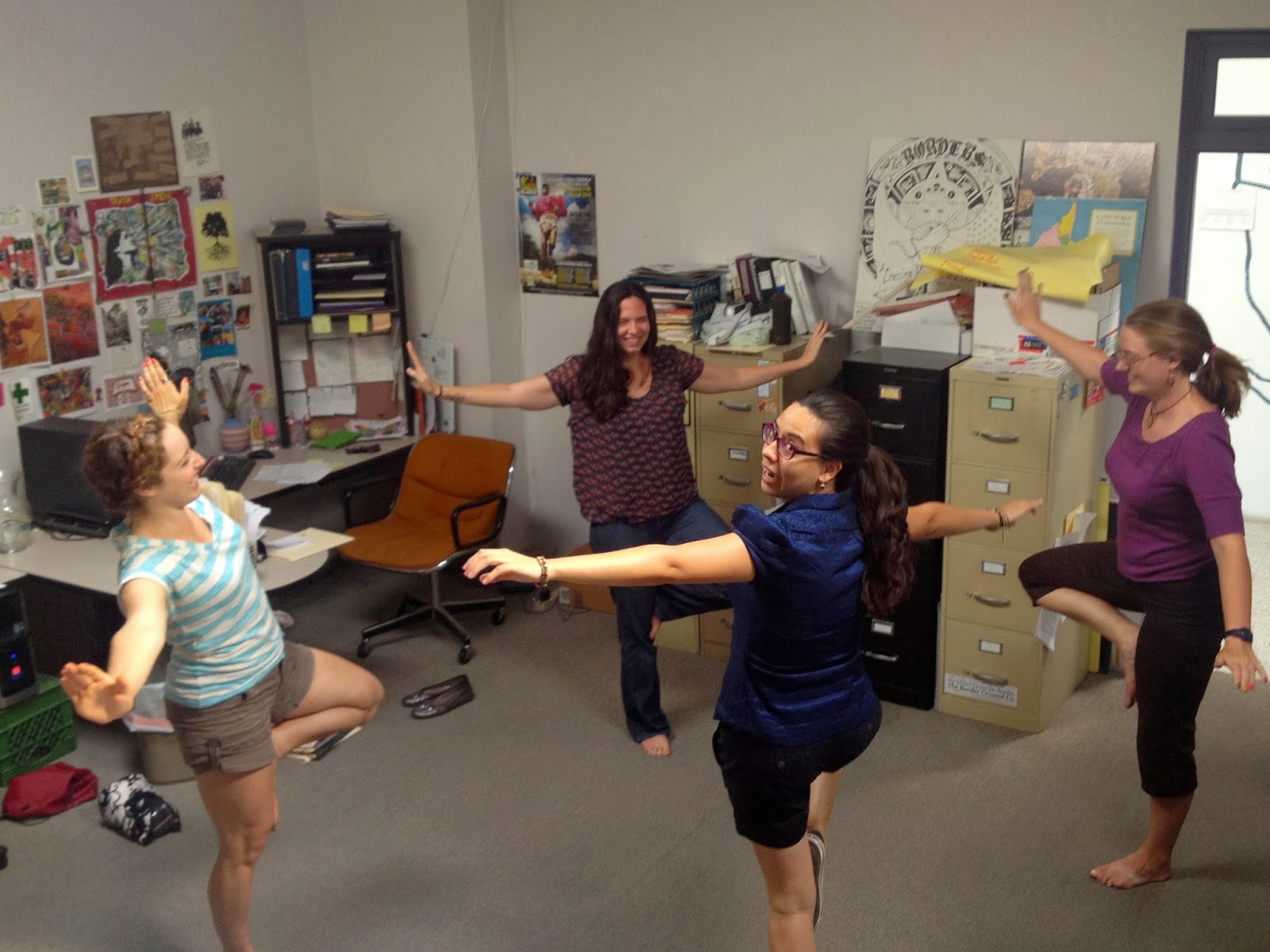
On a lighter note, as driven and reflective as my work environment is, one amazing practice they are trying to implement is five-minute exercise breaks three times daily. Here's a funny photo that my coworker Alex got of us attempting some yoga yesterday!


After some frustration over the wider world that I cannot control, more specifically two political letdowns today that do not directly affect me but they do because they affect the health of our people (see my P.S. for the ten-second versions), what I can control is how I choose to work (which is a privilege) and what I choose to celebrate (this anyone can do!). Today I'm thankful for yoga and exercise breaks with my team at work. I'm thankful for the chance to see via Skype my significant other's face that is significantly far away. I'm thankful for getting surprised on the phone by not just one Carleton bestie, but five who all happened to be in Northern California together for one night. I'm thankful for a doorframes for climbing and a hallway long enough for cartwheels (and potentially bowling). I'm thankful for extended housemate hugs, communal decision-making, and roommate dates.

There are so many things I want to write about, but I'm also going to practice what my dear novio (and anyone else who knows me well) has to remind me, to not spread myself too thin and go to bed. 

¡Buenas noches!
Kathryn


P.S. If you wanted to know why I was upset with the political world, these are two topics I need to go more in-depth on in futures posts, but here's the brief spiel: 

1) The House voted to cut $40 billion dollars over ten years from the SNAP (food stamp) program. This is a program that expands and contracts based on need, and when one out of six Americans are dealing with hunger and food insecurity, how can we afford not to support getting food (and good food) on the tables of the most vulnerable? Thankfully the Senate and House have to come together to pass a unified bill, so if it's on your heart to prevent these devastating cuts to this program that really does save lives, I urge you to sign petitions and email/call your representatives soon and often!

2) Good job California last week for expanding drivers' license opportunities to DREAMers! However... my new state of residence swung the complete opposite direction. New AZ legislation actually expands a driver's license ban to bar not only DACA recipients (undocumented youth who came to the U.S. before the age of 16 and who applied for and received this 2-year provisional status), but additionally, "the expansion would deny licenses to immigrants who have been allowed by the federal government to remain in the country for humanitarian reasons. They include survivors of domestic violence and victims of human trafficking and sexual exploitation.. One of the additional categories subject to the extended ban covers immigrants without sponsors, among them victims and witnesses to crimes." As my momma taught me, "If you have nothing kind to say, say nothing at all," so because I am still a little bit livid about this, I'm going to sleep on it, formulate my thoughts, and pass this article on to you: http://www.reuters.com/article/2013/09/19/us-usa-arizona-immigration-idUSBRE98I02Y20130919

Okay, good night for real!

Monday, September 16, 2013

Rare Moments of Brilliance

Once in a while, snippets of perfect phrasing fall out of my mouth or out of some corner in my brain, and since the limits of my brain would probably never again find that phrasing in quite the same way,  I try to write things down immediately. Long story short, from conversations over the past few days, here are a few phrases I would like to share with you.

Think big picture and do small picture. So the food system in our country is really messed up. I challenge you to think about how healthier food in this country is more expensive, how we approach food aid, how we approach animal and environmental rights, how our government prioritizes certain practices over others through subsidies, and how our demand and consumption affect other countries, as well as play a role in forced migration. From those thoughts, what can you do? Start a community garden? Talk to your representative about the Farm Bill, food stamps, and subsidies? Ask your uncle who farms what changes he'd like to see? What can you do right at home that connects with the big picture?

Start small but do it on a big scale -- it will make a huge impact. You can start doing "Meatless Mondays" by yourself to reduce your own environmental impact, but you can also do it with a friend or a few, or your community. Even if you do not get a huge number of people to do it, you will at least get a huge number of people involved in the conversation. 

Never stop being church. And because "church" itself is such a loaded word, what I mean by that is never stop being forgiveness, grace, compassion, community care, and love. To others, and possibly harder, to yourself. I’ve said it before but I’ll say it again, only when you are filled can you overflow to others. And that should happen not just when you take the time out of your day or week to intentionally practice the rituals of your belief system, but how you should live all the time.

Sunday, September 15, 2013

Mission: Understanding

I believe every YAV if they haven’t already, at least once this year will struggle with the question of “What am I doing here? What is my purpose? What good am I really doing?” And for me, more specifically, this year is a journey to figure out where I can best serve humanity in the field of Latin America-related social justice. What is amazing is that I am definitely in the right place. I am constantly amazed by just how much is going on in Tucson, and how much people are thinking and doing about immigration and food justice. (If you are curious as to why I use immigration and food justice in the same breath, hopefully reading more of this blog will make that become clearer). I will continue to update you all with more thematic posts as soon as possible.   

Before I launch into an externalization of an internal conversation, a note: I actually started this post days ago with many thoughts boiling and simmering at random intervals, and as I had finally written the introduction Saturday morning, it became even more powerful within the context of my intentional community here at the YAV house. One of my fellow YAVs who has become one of my Tucson sisters in such little time has struggled with a process of discernment (something Presbyterians really love doing) that has resulted in a decision to leave the YAV program. For her, confronting that “What am I doing here?” question brought mystifying results rather than confirmation that this was the right place. Arial has found this is not the right fit for her, and we can all see that what she is really meant to do is go back to Colorado to teach. She has such a gift for retaining, synthesizing, and sharing her knowledge of history, and she takes such delight in it, which in turn makes us even more intrigued by the historical tidbits she shares with us. We are all deeply saddened by the loss of her giggles, her thoughtfulness, her intense drive to run almost every day in addition to having the longest bike commute, her fun facts, and her overall spirit that she brought to this house, but I for one have the sense that her place is back in Colorado in front of a classroom, and we just want all the best for her! 
  
In these first couple of weeks of work with BorderLinks, I have been oriented through meetings and conversations to many of the projects I will be working on, as well as all of the aspects of organizing and leading delegations (something I still feel thoroughly unprepared for, but I'll get there). While getting the hang of office culture, who to go to with questions, the different workshops we offer, and my various responsibilities and projects, I have been challenged to answer questions like, “I thought you were going to be doing justice work or humanitarian work – what are you actually doing?”

This has a complicated answer. BorderLinks is an educational organization that holds workshops as well as takes delegations down to the border and into Mexico for participants to see and hear a broad range of voices related to immigration and food justice issues (To check out BorderLinks for yourself, please peruse our website (which it will soon be my responsibility to update!): 
http://www.borderlinks.org/). As half social media master, half Program Organizer, I will organize and lead delegations, as well as manage our blog, Facebook, and website. In both of my roles, I try to create spaces for critical thinking, dialogue, and greater cross-cultural understanding about the border and the larger systems at play. In order to actually do my job, I have a lot of learning to do first!

I really could just read immigration justice- and food justice-related articles endlessly and let them pull at my heartstrings, inspiring me again and again to do something in this field. And as my main goal this year this year is to have a better sense of how I can put my skills and gifts to good use in the immigration justice movement, my main objective through BorderLinks is actually to create those spaces for others to see, think, and act, as our motto declares. BorderLinks was actually founded in part by Rick Ufford-Chase, our host for YAV orientation in Stony Point, so it was fun to see some of his influence still very much present in this organization, such as the circle of praxis (see, think, act, celebrate). As I much as love to learn and reflect, the challenge is to be reflectively guided into action: the third part of the circle of praxis.

This kind of systems-focused, theoretical, critical thinking work is so essential so that we know how to better do and understand the need for tangible, direct humanitarian work such as putting water out in the desert, walking the trails and calling out "Somos amigos" in case people are in need of food/water/medical attention/directions, or even work with DREAMers to get financial aid for college like I had the privilege of doing in my AmeriCorps work with the Northfield TORCH program this past year. What are you going to do with that knowledge and those reflections? Tangible work is so much easier to explain! And also oh-so-necessary. The amazing part in Tucson is how these organizations are collaborating while addressing different needs in the immigration movement. However, the constant struggle with BorderLinks’ line of work is that it is nearly impossible to see measurable results (I encountered a similar struggle in my work with Witness for Peace as there is always more injustice out there to tackle and more awareness to build). How many minds did we directly catalyze to go home and work to make their communities safer and more hospitable to immigrants? Education-based social justice work can sometimes be so hard to connect to action upon knowledge and reflection, especially since we attempt to remain politically neutral.

However, one thing my supervisor said struck me: “All education is political in the sense that it either reinforces or challenges the existing system.” But how do we as an organization balance the desire to work for justice while intending to create space for voices not often heard and space for participants to come to their own conclusions? How do we create a balanced itinerary on our delegations when the choices we make about what/who we expose our groups to have such a force in shaping participants’ experience? 
  
So many questions to think about, but what am I doing? I am settling into a routine where I challenge myself to post on BorderLinks' Facebook page by 9am, so I basically get to spend the first half hour of my day updating myself on all the latest immigration-related news, articles, and community events, which is such a healthy practice considering I'm so interested in the topic that I would love to do that anyways. Every day, one way or another, I’m challenging people to be informed, to formulate their own opinions once they have a sense of what’s out there, and to act according to those beliefs. Especially when the name Kathryn goes up on the delegation leader schedule, I will personally be responsible for creating and framing a space for others to experience the borderlands firsthand, process what they have been exposed to, and (fingers crossed) catalyzing them into advocates for immigration justice, just as I was catalyzed on my BorderLinks delegation with my home church, St. Luke Presbyterian, in 2007. And look at me now. 

I may want to jump in full force into the world of activism and peaceful protests, which I may to a certain extent, but while I so admire people like my housemate Steph for putting herself at risk for arrest in solidarity with the people and the causes she was working for as a YAV last year, I will be a lifelong learner with a desire to work on a more systemic level. But make no mistake, I will also “do” by getting as involved in this community as I can as both volunteer and learner. At this point, I know this much:  I want to share the knowledge I have banked, the questions that emerge from the many revolutions and the squishing and stretching of that knowledge in my brain, and the reflections and best attempts at conveying and encouraging understanding. Actually, what is ideal for me is probably to navigate the borderlands of affecting systemic change and tangible, hands-on work with visible results, and perhaps my year will evolve to that effect. 

I am still getting into the swing of things, but I will attempt to frame this year as Mission: Understanding. (If you haven’t read some of my thoughts about mission, I’d advise you to take a look at my entries from YAV orientation). Mutual understanding and cultural exchange can only truly happen on equal footing, where there are words spoken and reflected on, where the hearts of all individuals start to open to and trust one another, where both (or more) groups can both listen and share and be both consumers and producers of individual stories. 

I’ll pull this point out from a recent staff discussion as well: even if we are seekers of knowledge and experience through this alternative education model, we must not be simply consumers of others’ time, others’ stories, and others’ trauma, even if our intentions are entirely empathetic. That serves to reinforce an imbalance of power in that relationship. We must treat whoever we meet as holistic human beings who may have come to the shared space on different paths, but also as people who like sports, spending time with their family, learning, etc. In the true model of popular education, everyone is a teacher and a learner. Even Kid President has that figured out (For your enjoyment: http://www.youtube.com/watch?v=RwlhUcSGqgs)! We must not simply interrogate, bank that knowledge, reflect, and act on it, but we can be partners in processing, mediators between cultures, relationship builders. We also must learn to hold our personal stories as valid and to be vulnerable when we are asking others to be vulnerable with us too. In this mission of experiential education, we must focus on learning from each other and perhaps reframe “education” as cultural exchange. 

So what can I do? I can work with my head and with my heart. I can seek to get a good grasp on the systemic injustice that perpetuates suffering and share that knowledge with others, so that they may also be filled with not only knowledge but emotion that moves them into action. As I am learning and finding my place, I encourage you to find your place. 

But no matter your role, I challenge you to better understand these issues. These fundamental human issues like the most basic need of feeding one’s family that have gotten so complex as we humans collectively have created unequal systems of resources, markets, and fronteras to those resources and markets. I challenge you to do your research, practice being a more welcoming neighbor, and partner with me in Mission: Understanding. 

Peace,
Kathryn


P.S. If you’d like some ideas for resources to check out, or just want to drop me a line with your thoughts and questions, please do not hesitate to email me at kemschmidt@gmail.com!

Sunday, September 1, 2013

A Week in Photos

After not really having many of my own photos to show for YAV program orientation in Stony Point, New York, I wanted to make a point of sharing with you all a little bit of what site orientation for our first week in Tucson looked like. On Tuesday, September 27, I woke up ridiculously early in our new time zone in our brand-new house with brand-new housemates to begin our year together!

A few hours later, here's Arial up and alive! She got in from her flight saga after the rest of us went to bed, and as we milled about figuring out how to use our first few hours, we sunk into our living room furniture to watch some TV and work up the energy to start cleaning our house to make it our own.

In the process of cleaning, we also discovered an uninvited housemate left by the previous tenants under a dresser. At certain times, it has felt like a lot of things were out to get us: moths, cockroaches, a mouse, other strange insects we had never seen before, a mug that decided to become two pieces in my hands as I literally was just washing it gently in the sink, the sink itself, mosquitoes (which we absolutely did not sign up for, coming to Tucson's reputed dry heat), dust bunnies (two of my housemates are allergic), and other allergies. But we are living simply and simply living!

Here's a fun addition to our house: Arial's and my new bikes! Tucson is emphasized as a bike-friendly city, and so our dedication to simple living includes commuting and transporting ourselves on bikes. Our program gave us a bike allowance, and before we even got to Tucson, Brandon had found a couple of bike deals, so Arial and I chose to take him up on the offer of finding us these sweet and sturdy hybrids.
Those bikes were camped in our long hallway from which branches off all the other rooms (the house used to be a boarding house so the setup is pretty unique), and here begins the tour of our new abode. Once I discovered the ping-pong table on the screened-in porch, that was when I knew that this house was a keeper.

Here is the porch door out to the backyard.
 

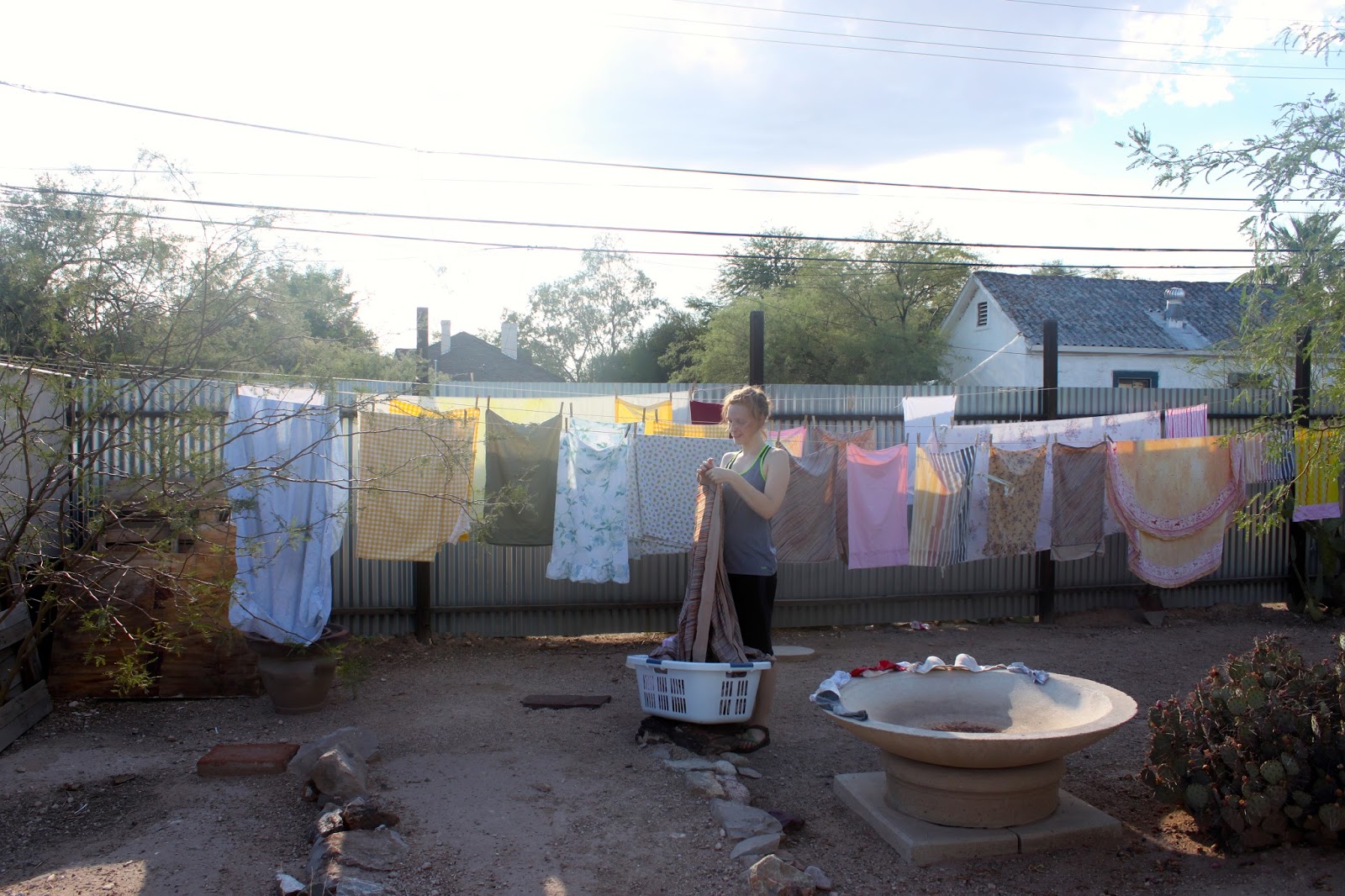
Our beautiful, zero-scaped backyard, complete with laundry drying in the sun and plenty of new vegetation to explore. While I may miss the lush green grass of Minnesota lawns, lawn grass tends to not be sustainable anywhere, much less in the desert. And it is a different feeling completely to wriggle your toes into warm sand. 

Palm trees, no big deal.

Birdfeeders.

This vegetation is really fascinating to me. I love the angles and shapes in how this cactus takes form.

Beautiful Heather doing laundry in the beautiful sunshine.

The back of our new house!

Oh, and we have chickens! The YAVs from last year invested in two chicken coops and ten hens that we will take care of in exchange for free fresh eggs every day!


To have and to hold...

Heather, after a year of working in a vet clinic, had the most primed instincts about animals (I really almost wrote animal instincts but realized that sounds funny...) of all of us, so her expertise was quite helpful in orienting ourselves to taking care of our flock.

The crazy chicken we needed to quarantine for her own safety, except chasing her around the yard and then out from under the smaller coop to put her in was a process in itself. And she earned the name Loquita.... (which means Little Crazy One)

Poor girl is either picked on by the other chickens or simply excluded from the communal food at feeding time, so we felt it was best to give her some individual attention in her own coop.

Hey!

"Do you mind? I'm trying to lay here!"

Amy Beth and her excitement about our new yard!

Another important way of settling into our new home was of course finding our way around the kitchen, so we tried our hand at maneuvering a few bodies around the tight space and turned out a pretty decent lunch, featuring guac made by Amy Beth.

Arial and Amy Beth preparing ingredients.

And Heather just looking adorable! And also preparing ingredients. Heather is adorable all of the time, but what really made me choose this picture over others is of course our coordinator Brandon's face in the background.

At the tail-end of monsoon season, the skies change at the drop of a hat.

We did a lot of cleaning this week, but we had to make sure we broke in the ping-pong table too.

Our first home-cooked dinner! The first night we were treated to pizza by Steve, one of the Tucson YAV board members after he helped us clean our house for half the day! We have some amazing support here, and I look forward to many more dinners with these folks.

Here's our first spin out on our bikes: Brandon rode with us to our bike safety class put on by the City of Tucson that is so invested in creating a bike-safe city that they made it free for everyone and set up a deal with a local bike shop so you can choose two out of three items for free as well: helmet, bike lock, and lights. All we had to do was devote a few hours of our time to our instructor Jorge, and we would be provided with knowledge and free equipment to hopefully keep us alive and well for the year.

Heather backpacking-up for the ride. 

Here's us on another necessary errand: our first trip grocery shopping. Our intention was to go visit all of our work placements so we would get to see where everyone worked and we would feel comfortable with our commutes, but we ended up only having time for my placement at BorderLinks and Amy Beth's at Southside. We did have time to swing through Food City though (one of the plethora of grocery shopping options in this city!), and literally half of our cart (and then over half of our fridge) was fresh produce.  
    

So excited about healthy food!
 

While we started fending for ourselves in terms of preparing food, we would never turn away a free meal. Friday night, Brandon invited us over to his home in an intentional community about ten minutes away by bike. I am not exactly sure how many people live there, but they make a point of sharing meals as well as chores as a community. Brandon and his wife, as well as their two daughters, have lived here for the past few years, and it was so sweet of them to invite us into their home as well as into their community over the common feast. Before the meal was ready though, he brought us up to his roof to orient us in the city of Tucson, because apparently you can do so by knowing which mountain range you are looking at: Catalinas to the north, Tucsons to the west, Santa Ritas to the south, and Tortolitas (also known as tortellinis to us who cannot remember their rightful name) to the northwest.

I hope I never lose the sense of amazement at these skies.

The whole crew on the roof (photo credit: Ali Wood, Tucson YAVA and now board chair): Brandon,  me, Heather, Arial, Amy Beth, and Tyler.

Saturday morning was a bit of a long day because we had part two of our bike class. After almost six hours in the sun, we had passed our group bike ride, parking lot drills, test, and graduated with a sunburn. Heather was also the guinea pig to learn how to change a flat tire, shown here with our awesome instructor, Jorge.

Another thing that brightened my weekend other than an awesome house with incredible company with whom to share it for the next year was an unexpected visitor: this guy came to visit me! My novio Mauricio took on a 15-hour round-trip drive from visiting his family in Southern California to hang out with me and my new housemates for less than 24 hours - what a sweetheart!


Our final housemate, Steph, actually also arrived on Saturday, so our crew was finaly in full force. She is a fiesty personality from Puerto Rico with a huge heart and incredible passion for justice issues who felt she had unfinished business following her YAV year, so she decided to stick around for another year in Tucson to live with us and work with the Florence Project: "a nonprofit organization providing free legal services to men, women, and unaccompanied children detained by Immigration and Customs Enforcement (ICE) in Arizona." I so look forward to learning more about her work and her experience so far in Tucson!

There you have it, a few days in photos of new life in Tucson. More photos, stories, and reflections to come!