"Man, it's a hot one, like seven inches from the mid-day sun..." Santana
and Rob Thomas were the soundtrack to my night, as the fan in my room
made angry noises in the middle of the night so I turned it off and woke
up a little toasty without the moving air. But the warm weather meant a
perfect day for our first truly touristy experience, an afternoon at
one of Nicaragua's beautiful beaches! My host mama asked what type of traje de baño I was going to wear, as standards of modesty vary widely between countries and cultures, but for us extranjeros, foreigners, bikinis are just fine. And she was so excited for me
to be able to go - it is a treat for the average Nicaraguan. She said she had not been in seven years, and she will not be able to go for several more, when the kids are older. Many other host families were considering taking their delegates to the beach on family day as well, so some of our group would have twice the opportunities to get swept out to see by the famed undertow we were consistently warned about.
Before we would cool off in the refreshing Pacific, we got to get a little dusty and messy with art projects - my favorite! We drove to Taller Xuchialt, Xuchialt workshop, the community art collective supported in part by PML.

Paintings hung everywhere inside, including this one on the ceiling that references the indigenous sun god like we had seen in the Catholic church in Sutiaba. The name Xuchialt itself is the original nombre indígena, indigenous name, of this pueblo, but the Spanish could not pronounce it so they named the town Sutiaba. The founders of Xuchialt wanted the community to embrace its indigenous roots in name, symbolism, and forms of dance, music, and art.

This one was particularly close to home, as it combined symbols and elements from León and Minnesota to highlight the exchange relationship between Xuchialt and Perpich art school in Golden Valley, Minnesota, not too far from where I live!

Lenon, the sub-director, and a couple of profes who were probably in their mid-twenties gave us a brief overview of this workshop that promotes culture, is youth-run, and all volunteer. They have classes for guitarra (guitar), danza (dance), pintura (painting), and sometimes other subjects, depending on who, Nicaraguan or foreign, is available to teach them.
It has been a trying journey in its six years for its importance to be recognized by the community, but Xuchialt has done so well that some students who have graduated from here have become art teachers themselves. The teachers had all started as students, and with the support of projects like Minnesota/León were able to make this art school. They worked hard to get certification from Managua so that Xuchialt's students who take classes and earn certifications can see those achievements transfer almost anywhere else in the country, especially in better schools in Managua. And so you readers know, part of PML's ongoing financial support is dedicated to sponsoring scholarships to kids who want to attend classes here but may not be able to afford materials or the mensual fee of 70 cordobas, so if you are supporting PML, you are supporting the chance for youth in this community to learn and master beautiful, traditional forms of art! The teachers themselves completely volunteer their time and say they are "paid in satisfaction." Furthermore, when they sell their own work in the gallery, ten percent goes back to the school itself.
To see an example of some of the work done by the profes themselves, we went across the street for a tour of this enormous mural they collaborated on with students as well. Stretching down the block, it invoked symbols vital to Nicaraguan cultural history and cultural present, starting with the indigenous jefe, cacique Adiac and the tamarind tree (which Lenon and Meredith are standing in front of in the picture below). He was a proud indigenous warrior who defended his pueblo against the Spanish, only to be captured and hanged in the enormous tamarind tree, and this tree fell only three years ago after over five hundred years of life. Other symbols weave the histories and tales of indigenous and Spanish heritage, embracing tradition and encouraging today's generation to learn and understand their history.

In this section of the mural, the ferris wheel and carousel are a display of the fair of St. Lucia, linked to more traditional images to the right, the myths of the golden crab, other indigenous gods, and a big black snail, the source of the name Xuchialt/Sutiaba and a source of calories back in the day.

Another theme was how language is evolving through technology advances, as this scene celebrates accessibility of sign language, and another highlighted a mobile phone with messages in the native indigenous language. So in terms of modern communication, "The medium has changed but the message has not," my papa said.

This mural was pretty spectacular. Seriously. And the wonderful thing is they have room to keep expanding down the next block of blank wall, but that would take some funds to pay for the bureaucratic processes for that space...
With all its focus on indigenous heritage, the main style of painting Xuchialt promotes is called pintura primitivista, or primitivist painting, which became popularized especially during the revolution. In this style, you paint vivid nature scenes using simple, bright colors, and what really defines not only the genre but your own work is painting the trees leaf by leaf, and how you paint your leaves becomes your firma, your signature. Primitivist paintings can have a tendency to look rather busy, as they try to include a lot of details and animals, rocks, people, and plant forms in the scene.
Lenon demonstrated for us as he talked, and he whipped up this amazing primitivist painting in just ten minutes! We would all get a raffle ticket to possibly win his demo, but first, we would get to paint on our own! With some help from the profes...

Dad is inspired by Lenon's paintbrush placement for safekeeping (tucked within the curls) and also by Profe Soany's young daughter's skills and tips.

Our coordinadora Meredith became fotografa, our photographer, while we worked! I like bright colors and sunsets...

Pastor Don getting up close and personal with his painting.

Kira pondering her next element to add.

Leif putting his firma on the trees.

Lenon thought my painting could use a little more life, so he painted a garza, a heron, and then I attempted to paint another one reflected across it. I was pretty pleased with the result - thanks for the help, Lenon!

Thanks to some technique tips and added elements on our pinturas from the profes, we turned out a pretty decent batch of art! Not pro by any means, but at least we passed and could move on to the next exercise: alfombras de aserín, sawdust carpets. The reddish-brownish sawdust was used as the base for the carpet already laid out for us on the floor, and then a naturally whiter, more color-absorbant sawdust they dyed with a couple of our youth volunteers to make red, teal, yellow, blue, purple, black, and green. This art form is part of a hundred-year-old tradition unique to the city of León, passed down within families, and is now being disseminated throughout the country. Apparently it used to be that only on Good Friday would residents have a competencia, a competition, on a certain "Calle de Alfombras," street of carpets. This competencia has been a great way for the school to obtain some good press and standing within the community as out of over a hundred carpets, Xuchialt has gotten third and first in the last couple years!
Here Lenon shows us a small demonstration, and a dolphin leaped out of the sawdust in a matter of seconds it seemed.

We split into adults and kids (I was considered an adult for this one) and had our own little competencia. My team continued on the sea creature theme Lenon had started, we got to use some shells in our design as well, and our hands got dyed.

Don intently filling in the water as "Time's up!" was called.

Meanwhile, Zoany's daughter had changed into beautiful traditional garb to perform a folk dance for us following our alfombra contest.

Here's the youth team with Francisco helping and Zoany's daughter looking on. The kids decided to go with a theme of many of the symbols and myths we had been learning about, including a couple of their inside jokes from all they had learned.

Messy is best in my book!

She's so cute, looking at her mama the whole time as she took pictures. Accompanied by traditional guitar, recorder, and singing, she showed us a thing or two (that we would have to learn how to do in the coming days in our own folk dance lessons!)

Following this interlude, we had our profes and anyone else who wanted to judge the teams (our coordinators, other PML board members who showed up at Xuchialt, etc...) put in their votes, and adults won, no big deal, over the protests of the teenagers. To come full circle, after carpets are made and finished, they must be destroyed. Thus, carpet-wrestling...

... and carpet jumping!

Our final contest of the day was the raffle for Lenon's demo painting, so we were all instructed to draw slips of paper out of a little bag. While a raffle in our culture is perhaps more indicative of our tendency toward instant gratification and the first person's number drawn is the winner, here, they pick one number that loses, a second number that loses, and then the third number is the winner. And mine was the third number! I won a hug from Lenon and his painting to take home, ¡que suerte! (What luck!)

Many of us also bought paintings or t-shirts made by Xuchialt and its profes for more souvenirs from León and to support the school, so I actually would return home with three paintings: one I did that Lenon helped me with, Lenon's demo, and another in the shape of Nicaragua with nature scenes. We thanked our profes profusely, and then had a half hour drive to become playeras: beach-goers.
Suyapa, our lunch and afternoon destination, is a restaurant in the price range of many tourists but not many Nicas. The seafood here is supposed to be good even though León is not known for it, so many of us opted for something del mar, from the sea, while others got excited to have their first non-rice-and-beans, possibly American cuisine since leaving home. I was a personal fan of camarones a la plancha, grilled shrimp, with sides of vegetales and patatas, vegetables and potatoes. The youth may have been comforted by spaghetti, but perhaps the adults were moreso by the music selection of mainly American music from the '80s - Dad at one point exclaimed, "I have to come to Nicaragua to hear 'Love Shack'?!"

I ended up sitting next to and conversing mainly with Idalia, one of the board members and actually one of the fundadoras, founders, of PML. She gave me the PML spiel and how it started in the mid-80's as a cooperative learning how to build houses and take care of that community need with support from Nancy, a Minnesotan dedicated to serving León and working together. Idalia also gave me her Herbalife spiel, joking that after her husband passed away, she married Herbalife, a line of nutrition supplements and products she now swears by and tells many friends and acquaintances about. She said there is simply not much knowledge in society about what people are eating, the amount of unhealthy fats in the diet, quantity of food, and necessity of fruits and vegetables. Idalia swears by Herbalife products and say she is lighter, healthier, more energetic, and she is spending less money on food. It is great she has found what works for her and is working to spread nutrition awareness to her fellow Nicas - if you're intrigued, here is the Herbalife website: http://www.herbalife.com/
After some pleasant food and conversation, it was time to enjoy this heavenly black sands beach.

Our boys, Leif, Cody, and Chris jumped straight into the salt water.

Meanwhile, Paul, Dad, and Francisco tossed a frisbee in the sand...

... and they got our bus driver, Jose, in the game!

Francisco making Jose run a little bit.

These black rock formations and sparkling tides were just incredible.

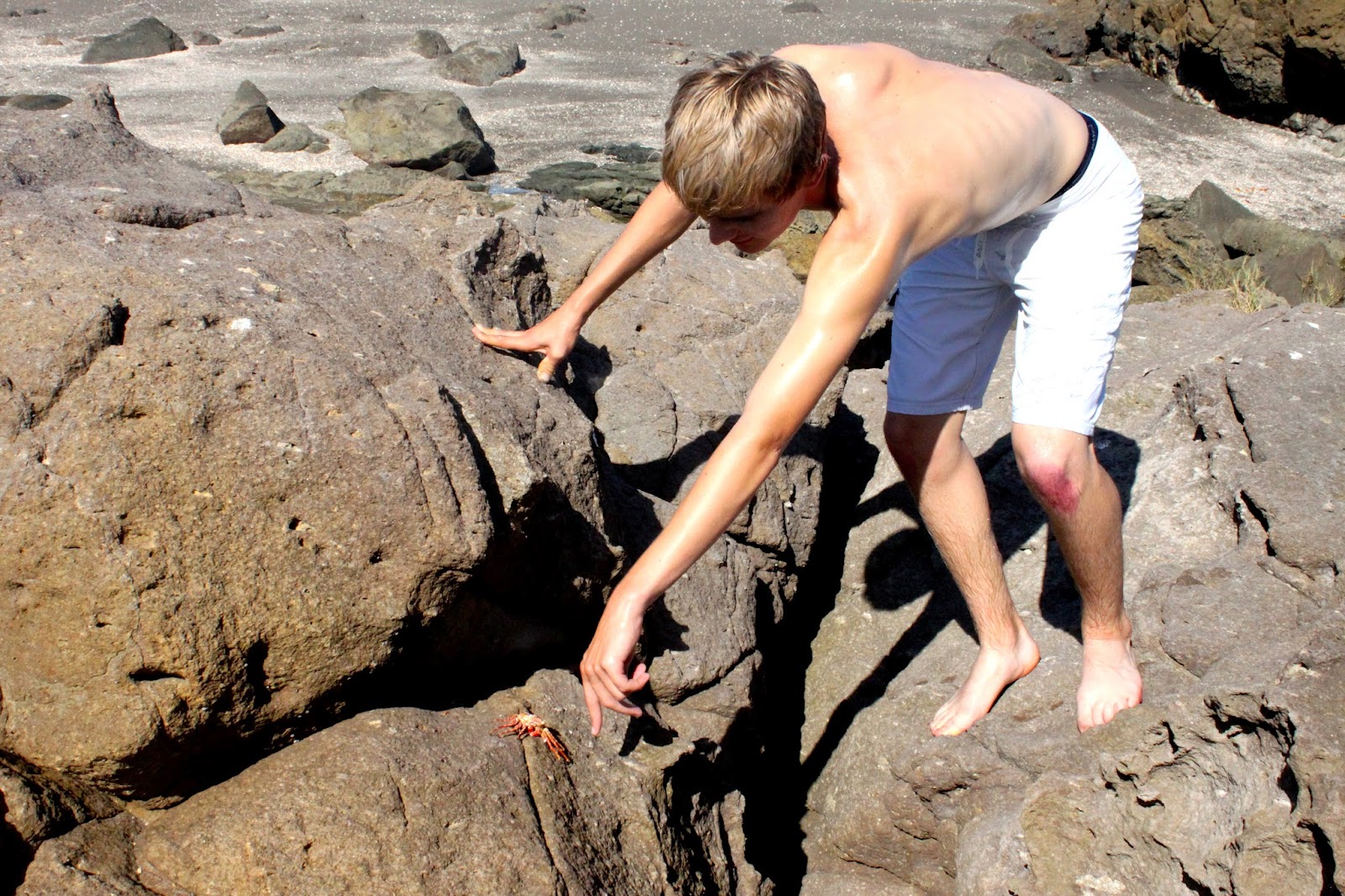
The boys took off running to go exploring the rocks, so I followed them to take some pictures and do a little climbing myself.

Herculean poses.

"Look, a crab! Oh, I think it's dead..."

Jennifer and I then left the kids to take a lovely beach walk all the way to a lagoon that forbade us from walking any further as we could have been pulled out to sea. But it was a lovely, relaxing walk and nice to get to know Jennifer better!

I had put my camera away after taking pictures of the teenagers, but Jennifer had brought hers on our walk and wanted to make sure I had proof I was here, so here I am!

When we got back to the group, I tried to convince my dad to do one of my favorite beach activities that I had been fortunate enough to do on the beaches of Rio as well, some beach sprints! Running long distances is not my thing, but I love a good sprint. Plus, running barefoot on sand is a harder and more natural workout. I threw out the idea to the group, and I was pleasantly surprised that Don said he would come, and then Leif and Cody, and then Joy all joined in. We did a nice jog the opposite direction Jennifer and I had walked, and I turned around and Francisco had come along too. For a while we just stood in the tide, letting the sand cover our feet and sinking into the earth. Eventually we headed back, Leif hit a real sprint so I took off chasing him and then did a couple more sprints back to our camp with Don. To cap off the afternoon, a few of us got some fudgesicles and a few of the adults had their Toñas and margaritas.
Overall, it was a lovely beach experience. It was not overrun with umbrellas, the ocean water was warm, and it was just so chill. And it really was great that Jose joined us for both lunch and frisbee. Especially people in positions of service and perhaps lower classes do not expect invitations or perhaps feel comfortable as part of the group, so he waits for an invitation from us and I'm glad our group has tried to make the effort to include him - he's pretty great!
Speaking of Jose, on our ride home, our microbus had a bit of an encounter. I so wish I had been able to capture this on camera, but we were barreling around a curve on the highway and had to slow down behind a truck, which would normally be no big thing. However, this time the truck swerved around a campesino walking his bull. On the highway. The truck veered left to cross over the center line and zip back to the correct side of the highway, and Jose went left to try to curve around the now trotting bull as well. It was kind of a close call, but Jose made it back to our lane to hollers and roller coaster effects in the back of the bus, only to see two men on bikes coming down the hill and zipping straight for the bull. We all turned around to see what would happen and were thrilled to see the bikers react quickly enough to split and go completely around this traffic impediment. Meanwhile, the campesino ran after his bull, whipping it for its disobedience. Crisis averted.
My host family actually did not even arrive until after Doña Patricia, my dad's host mom, had made sure everybody had a plate of food and then there was still food to spare for Jenifer and her three boys. Unfortunately it seemed the word had not gotten to Jennifer's, Don's, or Kira's families, so we missed them for the night, which was too bad! Doña Patricia's house was indeed overflowing with people and food, but we could have made some space for sure.
Gathering to eat.

Joy playing with one of her adorable host sisters.

My papa and his host family.
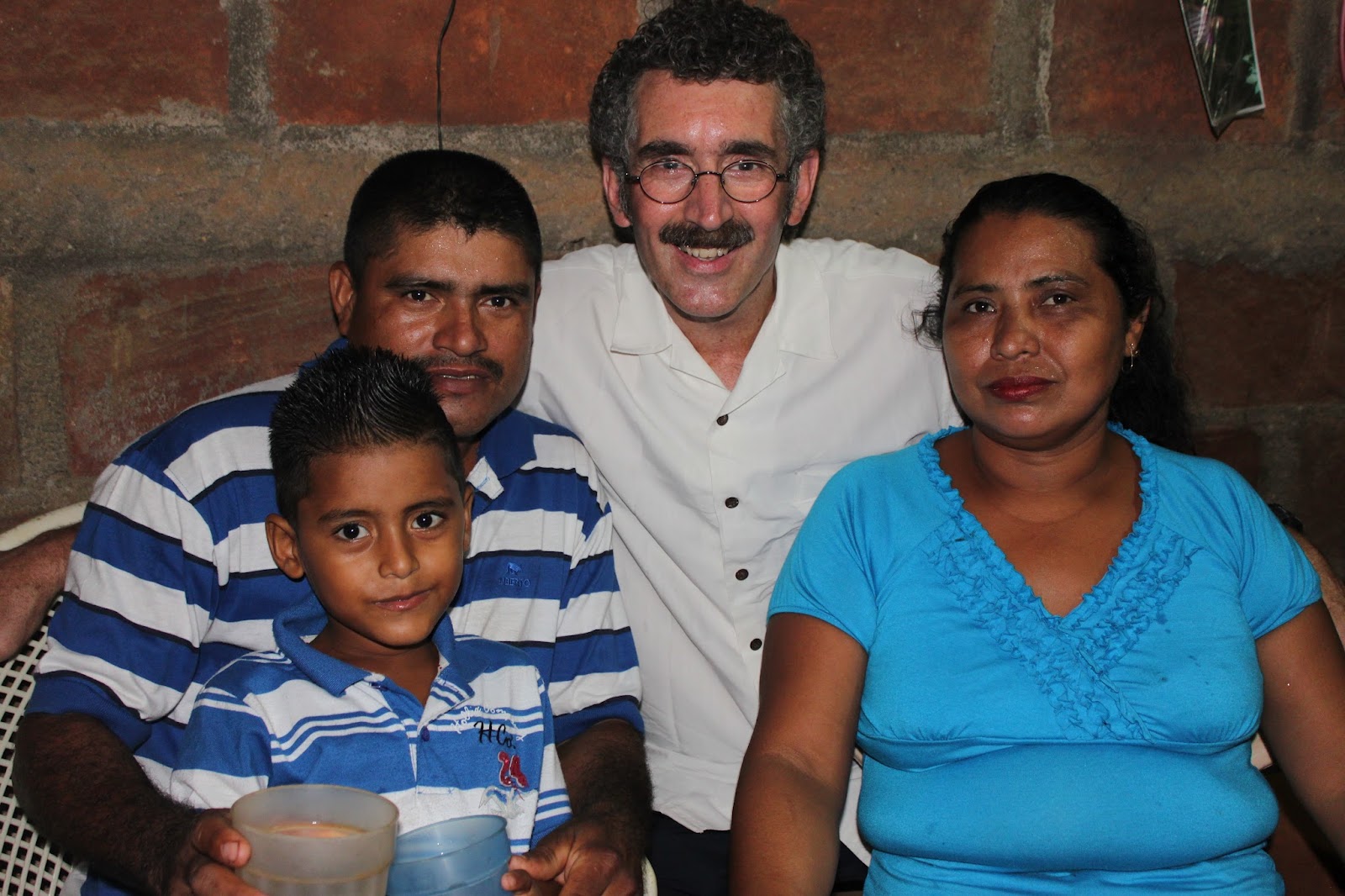
After we all had been fed, the youngsters wanted to run back outside to play, but my papa called everybody's attention to make a "flowery" thank-you speech, and I attempted to translate as best I could. He just wanted to share how meaningful of an experience it was for him even though just one week and that he was sad to leave. I helped him thank las cocineras, the wonderful cooks, his familia, and everybody else who made his special despedida, goodbye party, possible. Hopefully my papa and I will both get a chance to come back some day.
Thankfully we got an opportunity to take a group photo (sadly missing Don, Kira, Jennifer, and their families) - here's the crew!

We wanted to get a picture too. Here's my host mom, Jenifer, in the middle holding Diegmar, me holding Diederich on the left, Jessica on the right holding her son Derrick, and Diddier down in front, missing the photo memo.

As families peeled out, we stayed for a little while to help clean up, and Jenifer asked if she could take a couple chimbombas, balloons, home for her boys, which definitely made easier the longer route home with the stroller. The boys were a bit rowdy, so at least we had eaten before we got home because that would have been more craziness for Jenifer to deal with. She still had to cook for Douglas, and plus, it was his birthday! But he still would not be home for a while, and before the boys got tired out, a couple other random boys from the community came over and they all played with the balloons outside.
The oldest was about seven and really nice, and he sat and talked to me for a few minutes. I could actually understand him, unlike my silly host brothers! And in contrast to his more mature friend, Diddier, the four year-old, decided to bust out some sass with me because he thought I understood nothing... He threw some insults at me basically to test my comprehension, and I definitely understood him laughing after saying I danced like a cow and then moving on to some less savory words that are not fit for my blog, nor for spilling out of a four year-old's mouth. "Where did you learn those words, boy?" was all I could think, and I indeed asked him where he got that from and Jenifer said he has taken to following a couple of rebeldes, a couple older rebellious boys at school, and she desperately hopes he will grow out of it. Fingers crossed.
Eventually Douglas got home and the boys fell asleep, so I just hung out with my host parents for a while until bed, talking about various life topics. Things I learned:
- "Cuando esté seca, lo todo cuesta más" - when it is dry, everything costs more (in reference to foodstuffs).
- Here the nannying situation is the reverse from what it is in the States. In the U.S., nannies are hired by families who can afford them, while here, nannies are typically for poor families in which the moms have to work to support them.
- According to Jenifer, medicamentos (medications) are expensive, but the ones insurance makes cheaper no curan, they don't cure. Some people really cannot afford the meds they need, but Jenifer says "Sufro cuando otros sufran" (I suffer when others suffer), so even though she needs to help her family by running her farmacia, she gives them to people in exchange for what they can afford to pay.