Wednesday, September 15, 2010

Liaojie Tianjin

On our first morning in Nankai Daxue, we met in the lobby of the boys' dorm (dorms are mixed but our students are split so the girls are in doubles in building 2 and the guys are in triples in building 4) to go on a tour of the university. It's huge! We found the buildings for our classes but went on such convoluted routes in order to show us the gym and libraries etc that I still don't exactly know where everything is. I much prefer our tiny college in Northfield, but when you tell Chinese students the size of our student population they can't believe it! They're used to people, people, and more people.

Zhao Laoshi walking with Zhang Laoshi, an adorable little woman who helped introduce us to Nankai.


Our group in front of the building where we have our Chinese culture classes: The College of Chinese Language and Culture (unfortunately they cut the sign off in the picture...)


More of the scenes from our tour:


This is the place we can come order train tickets for our midterm break travels. Which will quite possibly be insanity because it happens to coincide with a Chinese holiday for which many students want to go home!


It goes without saying, but for the record, rivers really should not be this color.


Our tour ended in Xinancun (Southwest village), from where we could choose to head back to our sushe (dorms) with Zhang Laoshi or explore Xinancun. Most of us chose to explore, which was an excellent decision! Completely surrounded by food of all kinds, there are three main lanes to this market lined with stalls. The middle lane is actually a covered market with more stalls inside, so that was where many of us bought some basic necessities like a bucket for washing clothes, fruits (bananas are the easiest choice so you don't have to worry about washing), various snacks, small mirrors, etc.

I think people in Tianjin in general have seen fewer foreigners than Beijingers or Shanghainese, so people here are even more surprised when you can speak a decent amount of Hanyu. I had my first extended conversation with a maybe 60-year-old woman selling a huge array of school supplies whom we now affectionately "benzi lady" (benzi means notebook). I bought two really cute notebooks with Chinese painting covers from her, and she asked all about our studies. Discovering we'd be around for a couple weeks she insists we come back the next day (now we basically go to Xinancun nearly every day for a meal, so we always go visit benzi lady!). I also bought a few bananas and discovered asking for a "jin," the Chinese version of a pound, got me three bananas. But I also successfully bought some pretty good naicha, aka milk tea, aka bubble tea! It was yummy but I think it's whole milk, so I probably shouldn't do that again... I love the concept of buying fruit at a market though!


Liz discovered Wahaha brand water!


In the afternoon we then had a welcoming ceremony that commenced with a speech by the dean of the Chinese culture school. He talked about the university's long history with Zhao Laoshi's family (both his parents were physics professors here) and added, "You are now relatives of Nankai University - like our children." Our teachers were introduced, and our program's co-presidents Jake and Alex then gave a very entertaining speech as well. Then it turned to the rest of the tongxue (classmates) for us each to say a couple sentences to introduce ourselves. Our formal studies begin!

The next item of business was to tackle the cell phone issue. We all asked around about the best way to deal with what in the US is such a familiar item (and what is now definitely a popular commodity in Chinese cities too), so I ended up hopping in a cab with Kellianne, Alek, and James to go to Shoujicheng, Cellphone City. Its name was quite an accurate description. This place was huge! Another giant box with stores ringing the stalls upon stalls of phones and their sellers. The first item on our list was a SIM card, which ended up being quite a frustrating experience because of communication issues and the feeling of not quite knowing what we were buying. I'm waiting until we get to Shanghai to get a local SIM card there, but I tried to help the others as best as I could, and we think the ability to text and call and top up their minutes when they run out - we'll see how that works out! Buying the actual phones was the fun part because we got to peruse the huge selection from the numerous vendors, ask for their cheapest models and try to make them cheaper without compromising functionality. Alek was the first to snatch a phone and got his for 100 yuan - less than $15 - and it works! James drove everyone crazy by treating tanjia as a sport, so Kellianne and I laughed with the vendors in his wake as we tried to find suitable models for ourselves. James found a pretty awesome phone that looks a bit like a small robot but is kind of lacking in functionality and needs to be charged about every 10 hours. Kellianne and I had issues figuring out our perfect phone to serve our basic goals: 1) cheap 2) can contact people. At last we discovered an about 70-year-old woman who had what we were looking for, plus we just felt better about buying from a nice person (rather than others who scoffed at us when we asked for a cheaper price as deserved...). She had to do a few errands to help us get exactly what we needed, but we ended up walking away with functioning phones and chargers! Mine was 160 yuan and is super basic (and won't work until I buy a SIM card...), and Kellianne's does some crazy flashing lights whenever somebody contacts here! Stress but success.


Cell phones in hand, and thankfully all switched from Chinese to English, once the taxi dropped us off at the east gate, we discovered a most delightful treat: waffles! A woman had her vat of batter in her cart, made them on the spot, and dropped them into plastic bags to go (yea, that’s how to-go food goes around here). But these are neither Belgian waffles nor American waffles. No, these are distinctly Chinese and it’s kind of hard to pinpoint how. But by themselves they are sweeter than waffles we’re used to so no need for condiments, and they’re what James termed “inverse waffles” because instead of sunken squares, they’re basically circular puffs connected by batter webbing so you can tear them off and eat a puff at a time. We keep hoping she’ll be back!


And then it was time to celebrate Emily’s birthday! She had a hankering for Dairy Queen as we saw one from the bus into Tianjin, but we couldn’t figure out where it was, so a group of us wandered to the neighborhood filled with food on the other side of the gigantic street Weijinlu. Since she had a craving for American food, we searched for Alibaba’s, basically a restaurant/bar for foreigners we had heard about, but only after asking around and finally finding a couple guys who were going there did we figure out how to get there! We knew basically where it was, but it ended up giving off the appearance of a 1920’s speakeasy that was well disguised with the tiniest sign imaginable. Once you entered though, it was a decently sized establishment that seemed to be an explosion of everything China considered foreign – baseball on the TV, maps and flags from random countries as well as pictures of Bob Marley clothing the walls, and even Scattergories and other board games in the corner awaiting players.

Shiwu (foodstuffs) ordered: hamburgers, Americanized Chinese food, Chinesified Indian food, and pizza. Also a ping (bottle) of Qingdao, a famous brand of Chinese beer for Emily for her 21st! Something else inherently American arrived with our food: daocha! Forks and knives. Regardless of whether our food merited them or not. Hamburgers generally are not knife and fork food…


Getting into a routine kaishi tomorrow with our first Hanyu classes!

Thoughts on some China rumors I had heard before actually getting to China

Smog: Wasn't horrible while we were in Beijing, but we really had a lucky couple of days.

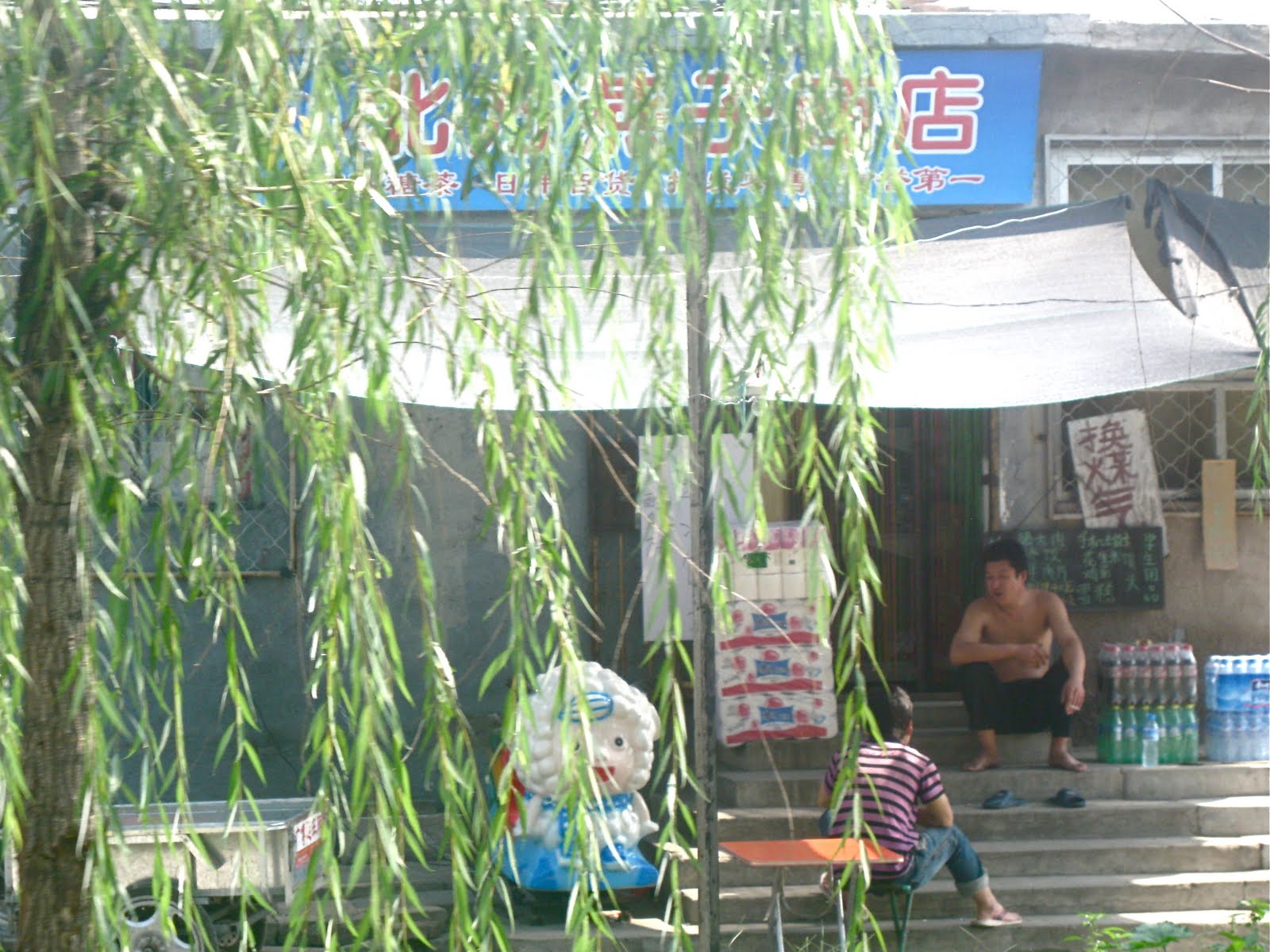
Heat: Yes, it’s hot and humid. And yet people don’t really wear shorts… But for some silly reason, guys are allowed to be immodest and roll up their shirts to cool their midriffs no matter the level of belly fitness.

Water quality: Some of the rivers look absolutely horrid. Others are quite clean. As for drinking water, you can get cold bottled water almost anywhere on the street for one yuan (aka less than 20 cents). You don't have to be too ODC while washing your face or showering - just be smart.

Noise: We're in big cities. Sure they're kind of noisy. The main streets have tons of cars, and they're loud, but the second you turn off a big street, there are tons of cute little streets that are quite quiet. It's just city life. Though I must say it seems like people are more prone to honk about any random thing, not just to get traffic moving.

Smells: I think we all expected it to smell kind of gross here. But we’ve been pleasantly surprised that there are lots of fun food aromas and only once in a while we’ll get what we’ve termed a “China whiff.”

Dirtiness: It’s still a developing country. The farther outside of a downtown you get, the less cleanliness you’ll find. But it’s no different than I expected, and you can manage to keep yourself clean (usually with the exception of your feet). I made myself dirty not because the China itself is dirty, but rather because chopsticks + slippery food = I haven’t splattered this much on myself since childhood!

Tons of red: Do restaurants actually have tons of red lanterns and decorations all over and make staff dress formally? Yep! Not just for foreigners – it was really comforting to see “real China” still holds onto such beautiful traditions and real people eat at those types of restaurants.

Bathroom experiences: Yes, you need your own toilet paper. What's nice is I've actually seen a bunch of public restrooms you can use. Outside of dorms and really nice places though, do be prepared to take a squat.

China in general: They do everything super-size here. Especially Beijing - everything was extremely spread out, a concept we'd think of as downtown plus suburbs, except the suburbs are still considered part of Beijing and Tianjin etc and also have innumerable skyscrapers.

Tuesday, September 14, 2010

Bai bai Beijing!

These last couple days have definitely been some of the crazier in my life, today included. Kellianne and I finished packing this morning, were a little sad that the directions said we couldn’t keep the amenities (thus the sad face with our cute hotel slippers), and did our RA duties of getting everyone in one place and turning in our room keys.
We then helped lead everybody with all their luggage through the bumpy streets and sidewalks, over bridges, and somehow through the 60-plus parked bikes back to the gas station to meet our bus again. Our tour guide today took us through what Zhao termed “real China.” “The Chinese workers, not the people in Beijing, Tsinghua Daxue, nor the Forbidden City, are the hope for the world.” In the big city there is of course still much evidence China is a developing country, but heading out into more rural areas you see lots of people working extremely hard, others sitting around outside playing games or waiting for customers, toddlers seated on their parents’ feet on beat-up mopeds, and many biking carts that look like they could fall apart any second containing their materials to bring to the market.


The Dragon Riders were headed to the best location to connect with the dragon spirit: Juyongguan. This is the section of the Great Wall deemed the best pass and was built the strongest in order to protect the order. This is the meeting place of two mountain ranges and where by patting one side of the wall, you’re saying ni hao to Mongolia!
A little bit of the Great Wall history and advice according to Zhao Laoshi:
- Whenever China has had its capital in the North, it has been strong as it’s the first defense against the “barbarians.”
- Masi, horse temples, have been built along the wall to thank the horses for their hard work.
- Mao also understood the importance of the Great Wall’s vitality to his reign as he had declared during the Long March, “ If we do not reach the Great Wall, we are not heroes.”
- “Bu yao paizhao, zoulu. Bu yao zoulu, paizhao.” Don’t take pictures while walking – do them one at a time because it’s too dangerous!

Along the lines of this last thought, going up to the Great Wall was a lot different than I had imagined because whenever I had seen pictures of people on the Great Wall, they had posed on flat areas. Much to my naĆÆve surprise, climbing the Great Wall involved stairs, and tons of them! You had to have been really determined to try and invade China from this direction!
Our first order of business before tackling the stairs was a group Taiji (tai chi) session (on the flat section at the bottom, of course). Many in our group hadn’t learned Taiji yet (that will come in a couple weeks), and a few of us tried to remember what Zhao had taught us in his Daoist Health and Longevity class.


It was time to take the stairs. We had two choices: the “hard way” or the “easy way.” Not like climbing tons of stairs through the mountains can really be easy… But everyone chose the hard way, and we set off at our own pace. My preferred method was to climb a bunch of stairs, stop and take pictures of the beautiful surrounding scenery, and set off climbing again.


Hey, look, we touched Mongolia!


Looking off to the Mongolia side, we saw the world-famous six day traffic jam that my family had told me about even before I got to China! It’s still going strong!


As I promised, I took a picture with my silly purple giraffe cheater chopsticks from my teammate Sarah somewhere famous in China!


We climbed and climbed, with the four-brick stairs truly being the bane of our existence. It took serious concentration to climb because the stairs were all different heights! Some Dragon Riders powered through all the way to about seven towers, but many of us reached the fourth and felt we saw basically what we came here to see. The wind whipping up the sides of the wall dried our dripping faces as we rested inside the tower.


Rob posed his panda backpack precariously on the tower ledge for a photo.


Like many who reached this tower before us, we grabbed a sharp stone and carved our mark into the stones.


The Chinese government always looking out for its people.


As Emily put it well, “Going up is a physical workout, but going down is a mental workout.” It’s easier to let gravity do the work, but the stairs are so steep, and the different stair sizes comes into play again, so you really have to watch your step. Some stairs are even curved! If you decide to pause, it’s even more of a dangerous because your legs just start to shake uncontrollably! My legs didn’t even feel tired, and yet I couldn’t stop them from shaking. But we did it!


We hopped back into the air conditioned bus and said bai bai to Beijing. Zhao took us out for lunch near the beginning of our three-hour journey to Tianjin, his hometown.
First impressions:
- The third largest city in China (that nobody in the US has heard of…) seems to still be in a lower state of development than Beijing (which Zhao said was true – Tianjin apparently started developing first, but stalled and is only now starting to catch up again).
- The smog here is quite awful. We’ve started measuring the air quality by picking out visual landmarks in the sky, and on days they disappear from view, that’s cause to worry.
- It’s really cool to see the different mix of architecture here, though it was created through less than cordial result of European colonialism and concessions.
- It’s the biggest bike city in the world! I believe it. Alongside roads five lanes wide of cars are bike lanes packed about ten bikes wide with about fifteen per line at stoplights.


Outside of Nankai Daxue Dongmen (Nankai University East Gate).


Our dorm rooms are much more like I expected for our stay in China. Thus, less than stellar, but totally fine. Minus the fact that when Kellianne came out of our bathroom (which happens to be one room with a shower tacked on the wall, a toilet, a sink, and a mirror) the first time she said, “So the story is, I lifted up the toilet seat and it came off.” And minus the fact that it took us a while to get our appliances to work (the desk lamps that came with the room still don't...), but it's all good!


Tonight is for finally being able to spread out our stuff and decorate somewhat. Tomorrow we get to tour Nankai Daxue, where we’ll study the next two weeks!